
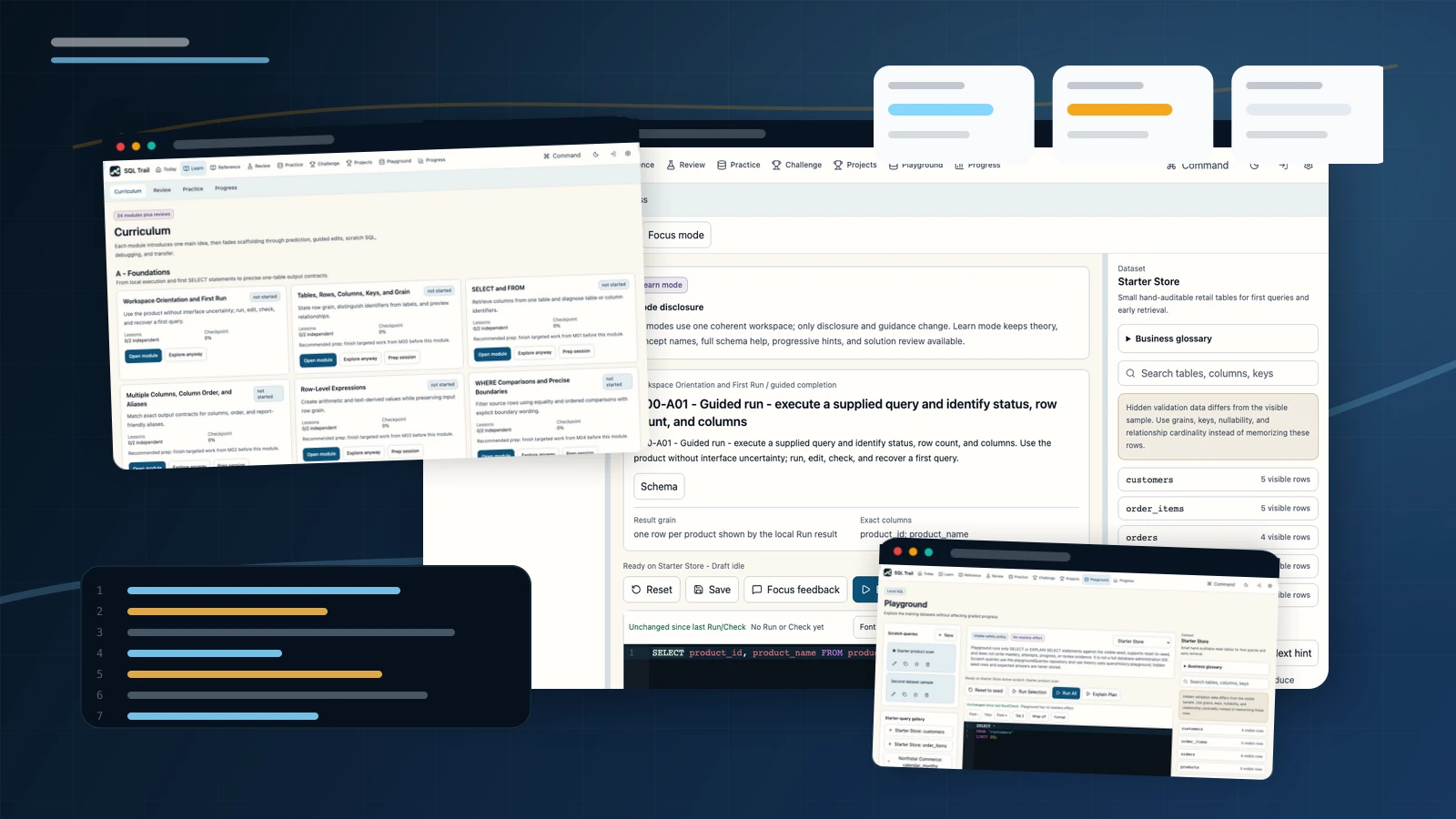
A complete learning system, not a video playlist
Use this inventory to scan the scope of the hub.
- What SQL is: a language for asking relational data questions with SELECT, filters, joins, groups, windows, and careful result grain.
- Who the course is for: beginners, analysts, engineers, interview candidates, and returning learners who want observable outcomes instead of passive videos.
- Learning outcomes include reading schemas, writing deterministic queries, explaining row grain, checking edge cases, and completing capstone projects.
- Course structure and roadmap decisions distinguish SQL fundamentals, analytics, application engineering, and interview preparation while moving from first SELECT through joins, aggregation, windows, data changes, transactions, indexes, cumulative reviews, datasets, and projects.
- A live example starts with a small SELECT, then the app checks hidden variants so the learner practices meaning instead of memorizing visible rows.
- Common beginner questions cover where to start, whether PostgreSQL is required, how long paths take, how datasets are used, and when to open projects.
Build your route through SQL
Choose a course, reference page, dataset, or project. Practice opens in the app when you are ready.
- Courses
- Complete SQL Path
- Analytics SQL Path
- SQL for Application Engineers
- SQL Interview Practice Path
- Sql Reference
- Sql Glossary
- Datasets
- Projects
- Methodology
- App
- Module 1: Workspace Orientation and First Run
- Module 2: Tables, Rows, Columns, Keys, and Grain
- Module 3: SELECT and FROM
- Module 4: Multiple Columns, Column Order, and Aliases
- Module 5: Row-Level Expressions
- Module 6: WHERE Comparisons and Precise Boundaries
- Module 7: AND, OR, NOT, and Parentheses
- Module 8: IN, BETWEEN, and Range Semantics
- Module 9: Text Matching and Normalization
- Module 10: NULL and Three-Valued Logic
- Module 11: DISTINCT, ORDER BY, LIMIT, and Stable Top-N
- Module 12: Scalar Functions, Types, and Casting
- Module 13: CASE, COALESCE, and Conditional Labels
- Module 14: Aggregate Functions and Null Semantics
- Module 15: GROUP BY and Report Grain
- Module 16: HAVING, Conditional Aggregation, and Safe Ratios
- Module 17: Keys, Relationships, Cardinality, and Join Planning
- Module 18: INNER JOIN and Qualified Columns
- Module 19: LEFT JOIN, Missing Relationships, and Zero Counts
- Module 20: Multi-Table Joins and Fact Grain
- Module 21: Fan-Out, Pre-Aggregation, Self Joins, and Non-Equi Joins
- Module 22: Scalar and Set Subqueries
- Module 23: EXISTS, NOT EXISTS, and Correlation
- Module 24: Common Table Expressions and Query Pipelines
- Module 25: Set Operations and Compatible Result Shapes
- Module 26: Dates, Timestamps, Time Zones, and Half-Open Ranges
- Module 27: Period Grouping, Complete Calendars, Cohorts, and Retention Foundations
- Module 28: Window Foundations and Ranking
- Module 29: LAG, LEAD, and Period Change
- Module 30: Running Totals, Frames, Rolling Metrics, and Percent of Total
- Module 31: Logical Processing Order, Systematic Debugging, and Data Quality
- Module 32: INSERT, UPDATE, DELETE, and RETURNING
- Module 33: Transactions, Constraints, and Upserts
- Module 34: EXPLAIN, Index Fundamentals, and Query Quality
Move from reading to a checked query
Use these guides to choose the next topic, then open the workspace for the editor, checks, drafts, reviews, and saved progress.